
|
|
PRESENTED BY
|

|
|
Here's what you'll find in this issue: - **This founder funded** his SaaS with services instead of going after VC funding. - **5 vibe coding tools.** Some of the latest apps for coding with AI. - **Yesterday's build board winners,** including three n
Here's what you'll find in this issue:
-
This founder funded his SaaS with services instead of going after VC funding.
-
5 vibe coding tools. Some of the latest apps for coding with AI.
-
Yesterday's build board winners, including three new product launches from indie hackers.
-
30-second growth tip: Change your growth tactic at every milestone.
Justworks handles HR, payroll, and benefits complexity, so you can focus on building your small business.
He quit his job at 50 to build a funded SaaS 👨💼

After 30 years in the corporate world, Günter Richter realized the "right moment" to go solo was never going to just appear. So at age 50, he made one happen. A few months after quitting, his one-person data consultancy is already pulling in $15k MRR. But he's not stopping there. He's using the services revenue to fund his real goal: a bootstrapped B2B SaaS.
Günter's consultancy leverages his three decades of experience and a massive professional network to land clients. He then funnels that predictable revenue into building Data Maturity Lab, his SaaS product, completely de-risking the typical founder journey. It's a classic stair-step approach that you don't see often enough.
In the full interview, Günter shares how he built v1 of his product in under 20 hours, why services-first was the right call, and how his network became his #1 growth channel.
Read the full article →
You have docs about your startup. Your AI has no idea they exist. 🧠
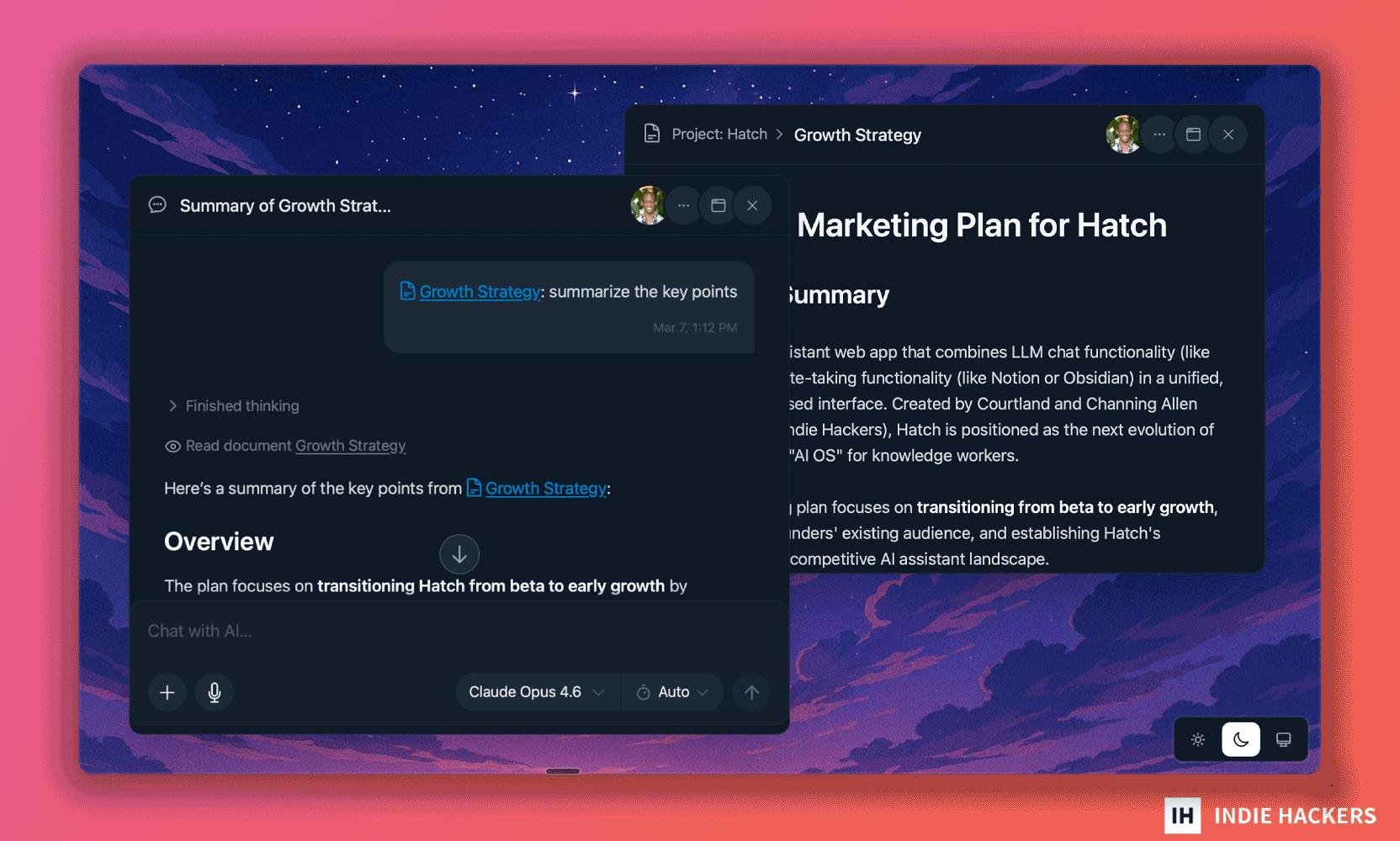
Think about everything you know about your business: your ICP, your pricing rationale, your competitive landscape, your roadmap, your lessons learned. It's probably scattered across Google Docs, Notion pages, and your own head.
Now think about how much of that your AI can actually use when you ask it a question.
None of it.
Hatch is an AI assistant where your docs and your chats live in the same app... and they talk to each other. Write docs about your business, tag them in any conversation, and your AI reads them before it responds. Not a summary. Not a pasted snippet. The whole thing.
What that means in practice:
- Write your ICP once → every marketing chat knows your customer, your positioning, and your voice
- Keep a running startup journal → ask “what should I focus on this week?” and get an answer based on what you’ve actually shipped and learned
- Store your SOPs and playbooks → get help that follows your process, not generic five-step guides from the internet
- Open any combination of chats and docs side by side in floating windows → work on multiple problems at once without losing context
Works on desktop, mobile, and offline. A guided tutorial gets you going in 2 minutes.
Try Hatch free. No credit card required. Use code INDIE30FREE for 100% off for 1 month.
Vibe coding tools to try 🧑🏻💻
-
Hatch: ChatGPT forgets you. Hatch doesn't. One AI workspace where your docs, prompts, and AI chats are all connected.
-
Kilo Code: Open-source AI assistant that orchestrates complex tasks, writes, and self-repairs.
-
Cline: Plan, act, and execute tasks inside VS Code with an open-source dual-mode agent.
-
Amazon Q Developer: Build and refactor AWS apps faster with AI that understands your stack.
-
Cursor: AI code editor that predicts your next edit and understands your project context.
See all 30 tools in the directory →
Bite-sized growth tip 🍪

Change your growth tactic at every milestone.
Turgay didn't use the same playbook to get from 0 to 100 customers. He used three different ones.
First 10 customers: direct outreach. Cold emails, personal selling, nothing scalable. The goal was just to prove someone would pay.
10 to 30 customers: SEO and blogging. Now that he knew the product worked, he invested in content that could bring in leads while he slept.
30 to 100 customers: onboarding improvements, educational content, and integrations with major e-commerce platforms. The focus shifted from finding customers to keeping them and making them successful.
Most founders pick one acquisition channel and grind it forever. Turgay treated each stage like a different game with different rules. What gets you your first 10 customers won't get you your next 100.
Read the full growth report →
The Build Board 🪧

Every day, indie hackers post updates about the products they're building. Here's what the community voted to the top yesterday!
Enjoy building in public? Post an update to your product page on Indie Hackers, and it will automatically be added to the daily leaderboard.
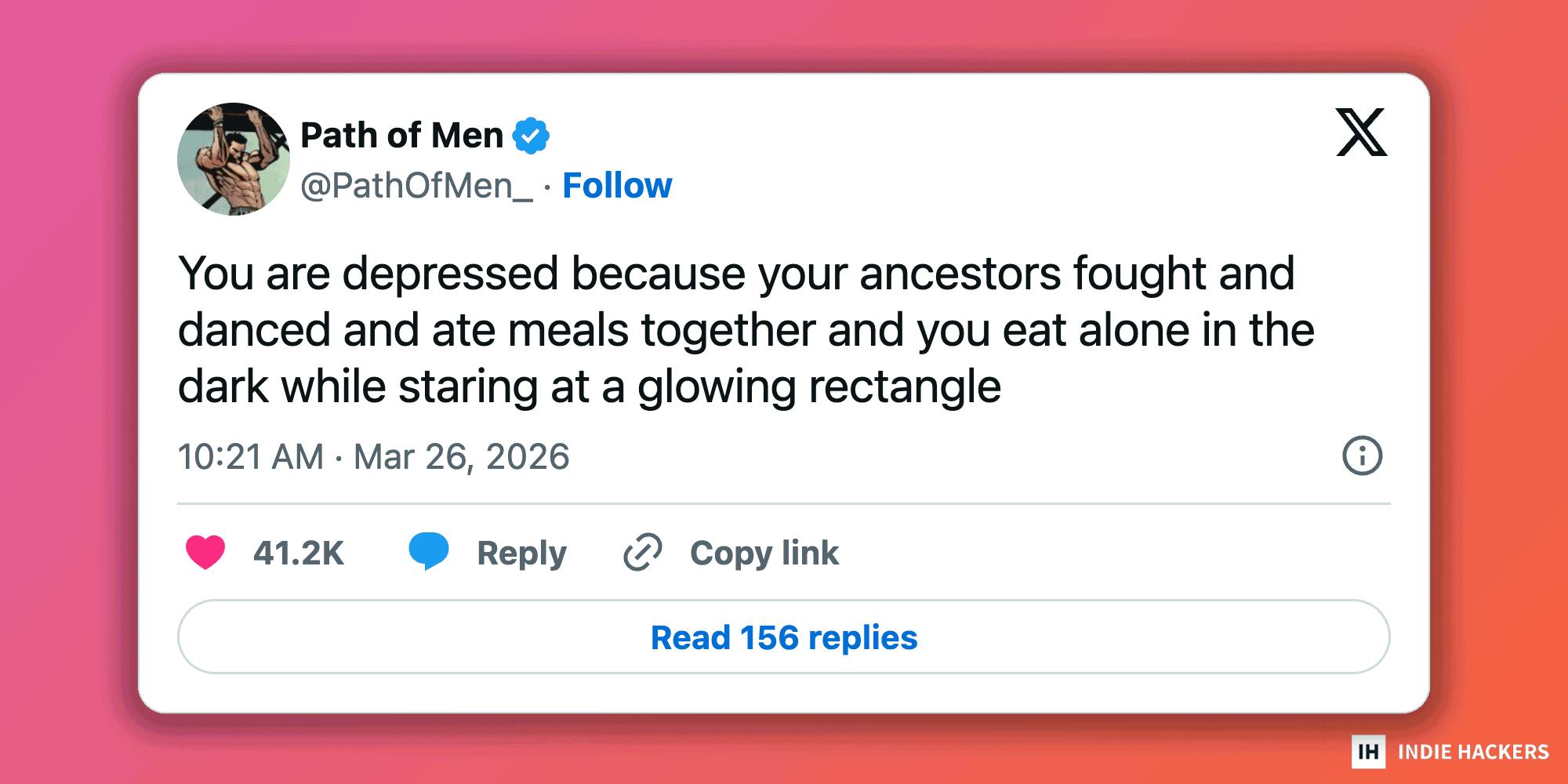
Channing's Tweet Pick 🐦
We'd love your feedback! 🙃
Did you like today's stories? Did they suck? Which ones?
We're constantly changing things up to make this newsletter more useful, so let us know what you think by replying directly to this email. We read every reply!
Special thanks to Yushavel Calderon for the graphic design, and to James Fleischmann for contributing a post.
—Channing
|
|
|
Indie Hackers | 120 Westlake Avenue N, Seattle, Washington 98109
|
|
You're subscribed to the Indie Hackers Newsletter. Click here to unsubscribe.
|
|
|


