| | | Hi! A quick heads-up: next week our staff is taking a long weekend, so TLDR will hit your inbox on Tuesday instead of Monday. We’ll resume our normal schedule after that. —The Editors
| | In This Issue | 8 min read |
|
|
| 🧑🎓 |
Vanishing student visas |
|
| |  | | Money squabbles can turn a happy relationship into a monster brawl. Below, some rules for lowering the heat. | Film Publicity Archive/Getty Images | | | The Week in Markets | | Ukraine in 2022 = Iran in 2026? | As the war in Iran enters its second month, the global markets inch closer to correction territory, and oil prices keep on climbing, investors are grasping for recent historical comparisons that might offer some clues about what’s next, and in particular they’re focused on the aftermath of Russia’s invasion of Ukraine in 2022. Back then, supply shocks in global gas markets caused an inflation spike, pushed up rate expectations, and caused a collapse in bonds and stocks — a rare double whammy for individual investors.
All you have to do is replace “Iran” with “Ukraine” and “oil” with “gas,” and you get why so many pundits, academics, financial analysts, and, increasingly, central bankers are getting nervous. But the fog is far too thick to trust any consensus, and it’s worth noting that Apollo’s Torsten Slok is one notable dissenter. He sees a four- to six-week overreaction driven mostly by misplaced 2022 déjà vu: oil hasn’t spiked nearly as much and inflation fears are far lower. Let’s hope he stays right! | | | | | | | The Chart of the Week | 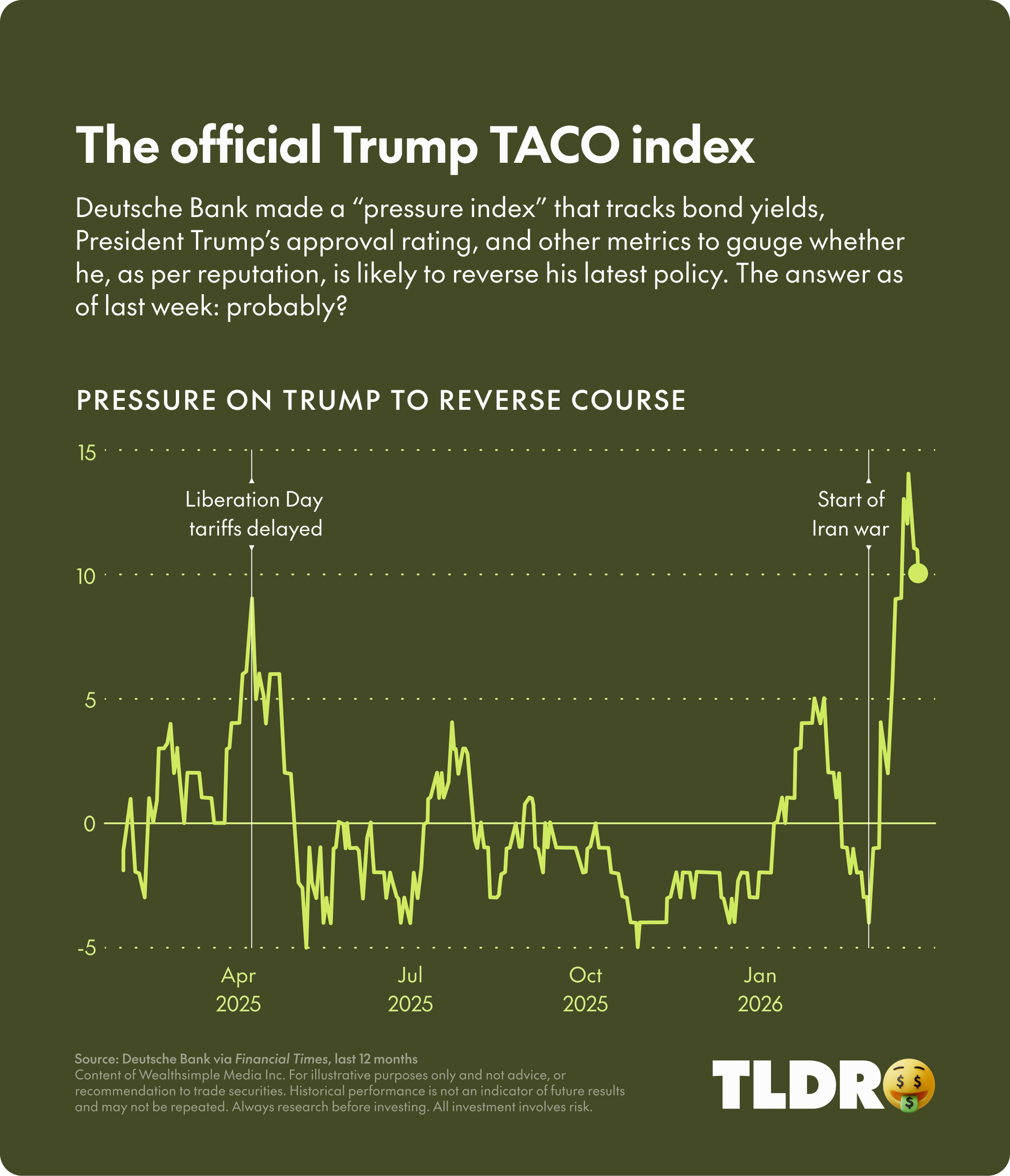 | | |
Ottawa tried to slow the influx of foreign students. They crushed it instead. Citing years of systemic fraud and a worsening housing crunch, Ottawa added new caps on international student visas in 2024, but it still forecast about 437,000 approvals. Instead, in the first six months of 2025, only about 300,000 students even applied. University systems, which heavily rely on foreign students’ high tuition, are now slashing programs and jobs to handle the multibillion-dollar shortfall. According to the Auditor General, even the federal department in charge of student visas was mystified by the plunge. Maybe the new stipulation requiring applicants to have $22,895 in their bank account has something to do with it? | |
Stock dispersion is soaring. Wait, what is that? The average between 99 and 101 is 100, right? But the average between 0 and 200 is also 100. Same average, much wider dispersion. That, in a nutshell, is the S&P 500 right now. The index is down about 7% since January 1, but below the surface, the double-thick fog of AI and war is driving historic levels of “dispersion”: energy stocks are up 37%, big tech is down 15%, and individual companies are up or down much more. Which means lots of investors are too. | 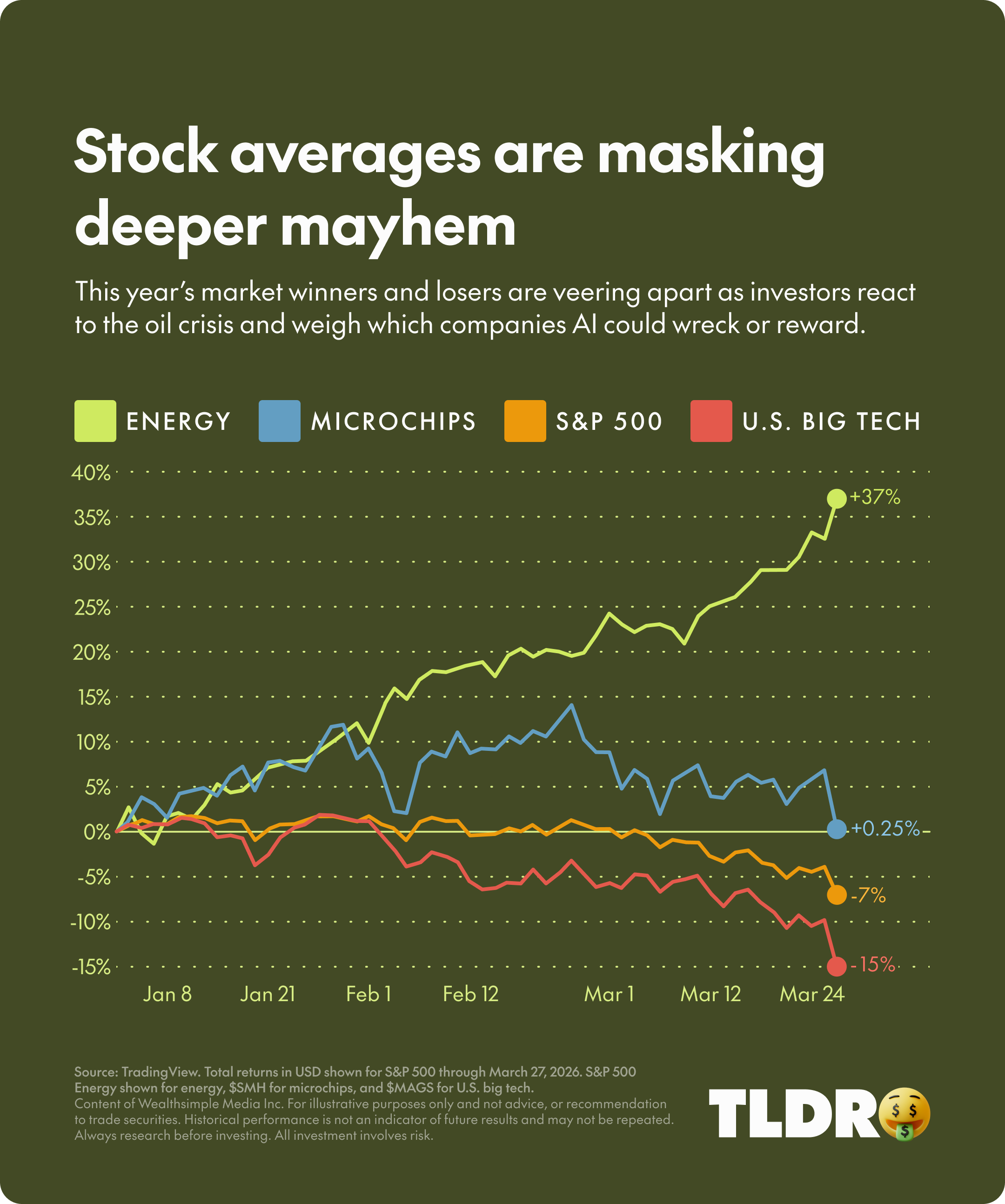 | |
The coziest new way to fly: couch class. At a time when airlines are squeezing economy seats, adding ever-more luxurious first-class inducements, and cooking up new ways to charge for basic comfort, United Airlines has unveiled an actual new idea for those of us living that coach-class life: the “Relax Row,” a three-pack of economy seats equipped with footrests that convert into a “lie-flat surface.” No price info yet, but it’ll be available on about 200 United jets by 2027, so it could be a game changer for young families and Mile High Club candidates alike. |
Is this social media’s Big Tobacco moment? One fascinating element of last week’s landmark California case — in which a jury found Meta and Google liable for a young woman’s social-media addiction — is how the plaintiff’s lawyers won: they targeted not content but platform design, e.g., infinite scroll and beauty filters. It’s the same legal playbook used against Big Tobacco in the 1990s, when the focus shifted from individual behaviour to engineered dependency. Tobacco users were so addicted, though, that profits kept on rising for decades — perhaps why Meta and Google shares didn’t totally crater after the ruling.
—Claire Porter Robbins
|  | | The FOMO Index | | by Stacey Woods | | Important | | 📰 |
NYT is accused of publishing a “Modern Love” essay written by AI. AI working on a response titled “And Just Like That—Something Inside Me Shifted.”
Source | | | | 🎢 | London is getting a Minecraft theme park. Londoners can go build a London without a Minecraft theme park in it.
Source | | | |  | |  |
| 🤩 | The Sora app is no more. Now if you want to star in movies or TV shows you’ll have to do it the old-fashioned way: by winning a contest.
Source | | | | ⚾ | The Blue Jays are offering fans a chance to act like they own the team. “Stupid move!” say fans who think they own the team.
Source | | | | | | Crash & Burn | |  | | To the Moon | | | 🥼 | Health Canada is recalling Shein gummy bear magnets over fears they’ll be ingested — and barely get you high.
Source | | | | 🤯 | Quadruple-amputee cornhole champion suspected of fatally shooting passenger while driving. Please be patient — we will get to all your questions.
Source | | | | |  | |  | | 🔗 | Instagram posts and Facebook reels will soon have clickable links. That’s right, we’ll be the last generation to write “link in bio.”
Source | | | | 📚 | Windsor woman is looking to sell her 2,000-book Harlequin Romance collection to one buyer. Ideally, a handsome prince on a valiant steed.
Source | | | | | | | Who Cares? | | | The Big Important Story | | Five Rules for Not Loathing Your Partner Over Money | Relationships come with all sorts of challenges, like negotiating different strategies for loading the dishwasher or learning to tolerate your significant other’s (S.O.’s) weird way of chewing or deciding whether it’s acceptable to use Disney as a verb (“Are we Disneying this year?”). But few things are as fraught as managing your money together. Heather and Douglas Boneparth, the married wealth-management pros behind the popular Substack The Joint Account, recently published a book on the topic called Money Together, so we asked them to help us draw up some basic rules.
Rule 1: Share a primary bank account. Studies consistently show that couples with a joint bank account tend to have happier relationships. “You want to have systems in place that promote teamwork and transparency,” Douglas explains. Of course, there are legitimate reasons not to share accounts, like if you have vast family wealth or a prenup (and, FWIW, the Boneparths are pro-prenup). But generally speaking, he says, “if you’re going to be a team, you have to play on the same court.”
Rule 2: Schedule regular “money dates.” Once a quarter, set aside a night to pour some cocktails, get close on the sofa, fire up Excel, and whisper sweet financial goals into each other’s ears. The idea here is to ensure that you are equally informed about your situation and avoid heated, in-the-moment disagreements. “Start with the wins,” Douglas says. Get on the same page about your short- and long-term goals, then recalibrate your spending/saving as needed.
Rule 3: Don’t compound a tragedy by being unprepared. “The worst-case scenario I encounter as a financial planner,” Douglas says, “is a partner who loses someone and they’re ill-prepared to deal with it.” Ensure you have authorized access to each other’s financial accounts so you’re not searching for passwords and stuck in financial limbo while paralyzed with grief. The Boneparths suggest devoting a money date to writing a “death note” (romantic!) containing passwords, account numbers, etc., and then locking it in a safe.
Rule 4: Agree on a fair-ish division of household labour. It’s almost impossible to split up chores and child-rearing fifty-fifty. One partner inevitably shoulders a larger burden. It’s important to acknowledge that, Heather says, and agree on a division of labour that both can live with. What doesn’t work is never talking about it.
Rule 5: Set an expenditure check-in number. Another transparency biggie: if a purchase exceeds a certain predetermined dollar amount, your S.O. must bless it first. No one likes logging into their bank account to find $3,000 missing because their S.O. decided to buy, say, a golf simulator. On the flip side, no one likes a tight leash. With any purchase below your check-in number, “you should kind of feel free to spend,” Heather says.
—Sarah Rieger & Jared Sullivan
| | | The Big Read | | 🪖 How American Camo Conquered the World | From ICE agents to trendy toddlers to Post Malone, everyone wants to be seen in camo these days, and one pattern in particular: MultiCam, which looks like it was designed by someone who works inside Minecraft. In this fascinating excavation at the intersection of money, culture, and politics, fashion journalist Avery Trufelman explains how MultiCam conquered civilian life. | WIRED*
*Article is paywalled, which, yeah, is kind of annoying. But we think good journalism is worth paying for.
| | | Post of Wisdom | |
 | | Thoughts on Today’s Issue? | | | | | This week’s newsletter contributors: Brennan Doherty (writer), Devin Gordon (writer), Claire Porter Robbins (writer), Stacey Woods (writer), Ambrose Martos (fact checker), Ciara Rickard (copy editor), Maude Campbell (copy editor), Sara Black McCulloch (fact checker), Eva Grace Clement Cruz (specialist, product engagement), Setareh Sarmadi (senior editorial producer), Matthew Karasz (markets editor), Jared Sullivan (senior editor), Peter Martin (senior editor), and Devin Friedman (editor-in-chief).
Disclosures: Contributors to this newsletter own shares in Google.
TWIM: Total returns shown for March 23 - 27 in local currency, via TradingView. | | | |