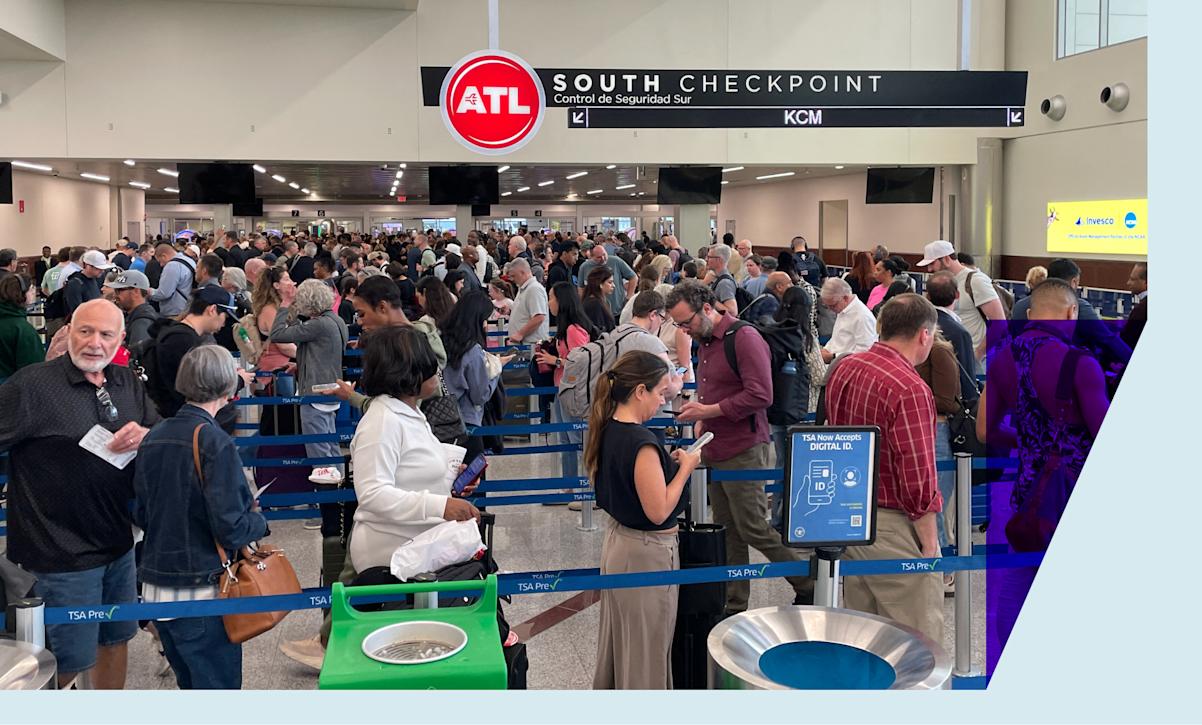
What’s going on: A "chaotic" spring break might sound fun to your college self, but the current airport disruptions aren't that kind of fun. The partial government shutdown left Transportation Security Administration (TSA) workers without paychecks — and now staffing shortages are causing hours-long security wait times at many airports. Immigration and Customs Enforcement (ICE) agents were deployed to 14 airports to help offset the staffing issues, but it’s unclear how much they’re helping — or what they’re actually doing. If you do get through security (and that could be a big if, unfortunately), there’s a chance your flight is pricier than usual. Soaring jet fuel prices tied to President Donald Trump’s war in Iran are pushing fares sharply higher — and airline CEOs warn there’s no quick relief in sight. And there are now safety concerns after a deadly crash on Sunday night at LaGuardia Airport.
What it means: When global conflict, government dysfunction, and essential staffing shortages all collide at once, we’re reminded how easily our travel system can crack. If shutting down agencies at the Department of Homeland Security (DHS) that handle counterterrorism and emergency response has you uneasy, you’re not alone. Perhaps newly confirmed DHS Secretary Markwayne Mullin has some ideas. On Capitol Hill, Republicans remain split on how to proceed, with some pushing a full funding deal and others backing a partial fix — complicating negotiations with Democrats and the White House. Even if lawmakers reach an agreement, Trump said he won’t sign any legislation that doesn’t include passing the SAVE Act, a provision Democrats strongly oppose. We’d suggest a road trip, except, you know, gas prices.
🗞️ Pfizer and Valneva want the FDA to sign off on its Lyme disease vaccine (which had a 70% efficacy rate in clinical trials), but it missed a key benchmark.
What’s going on: Yesterday, the Supreme Court looked poised to side with conservatives in a lawsuit that could invalidate hundreds of thousands of votes during the midterms. At issue is whether states can count ballots if they were mailed on time, but arrive after Election Day. The case focuses on Mississippi, which tallies votes that arrive up to five days after the polls close, as long as the postmark is valid. Republicans argue those votes should be tossed — a position that, applied to 2024, could have discarded 750,000 ballots. State officials counter there’s a longstanding precedent for counting delayed votes, dating back to the Civil War, when soldiers voted from the field. But at least five justices seemed unconvinced — a ruling that could ripple across 18 states and territories with similar laws to Mississippi’s.
What it means: Many analysts and politicians believe a ruling for conservatives would likely hit Democrats hardest, since they're more likely to vote by mail in many states. President Donald Trump has also discouraged the practice among his base (despite voting by mail himself). The case comes as some lawmakers push stricter voting laws through the SAVE Act — yes, the one that could make it harder for married women at the polls. It also lands against the backdrop of President Trump’s repeated claims that the 2020 election was stolen, despite evidence. A decision is expected in June or July — and it’s not the only case on the docket that could reshape voting rules just months ahead of midterms.
What’s going on: Women are pulling double duty — at home and at work. They do most of the unpaid (and unnoticed) labor that keeps households running: school drop-offs, never-ending laundry, meal prep, and everything in between. One analysis estimates that if women were paid for that caregiving, it’d be an industry worth $683 billion per year. Someone needs to cut us a check. A few companies have started to take note. Levi Strauss & Company offers immediate access to paid parental leave for both corporate and hourly staff. Meanwhile, AARP lets employees take up to two weeks off each year to care for older or ill family members. It’s progress — just not nearly enough, especially if you look at the numbers.
The data: A recent Pew Research Center study analyzed how men and women spend their days over a three-year period and found plenty of time gaps. On average, men clock about 90 minutes cleaning daily (we’d like to see proof), while women log more than two hours. About a quarter of all Americans act as caregivers, whether it’s for children or older family members. Women in their twenties, thirties, and forties devote nearly twice as much time on caregiving as men. And for those with children under 6, caregiving alone can take up at least eight hours of a weekday. It’s bad enough that women who take time off after having kids often struggle to find work, but they also end up losing an average of $237,000 in lifetime earnings, which can directly affect their Social Security and retirement plans. Hey, at least we all spend roughly the same amount of time eating?
❤️🩹 In her powerful essay, “My Season of Ativan,” Amanda Peet opened up about being diagnosed with breast cancer as both her parents were in hospice care.
🇫🇷 If you’ve been dreaming of a Parisian spring but airport chaos is getting in your way, French people ranked their Costco favorites. Magnifique.
BRB, reentering our Hannah Montana era today. The anniversary has us in a deep nostalgia spiral — courtesy of this playlist.*
When it comes to affordable skincare, French pharmacies do it best. This Embryolisse moisturizer is a classic. It's hydrating, gentle on sensitive skin, and many MUAs use it as a primer, too.
Psst…love our recs? Follow @skimmshopping on Instagram for more products, gifts, and services that are actually worth the hype (and the price tag).